
This post was written by Lydia from Mademoiselle Women
[AD: Camouflage, one of the books in this list, was given to me by the publisher, in exchange for a review at the time of writing.]
As an Autistic person, I am never really sure what to think about today. Autism Awareness Day takes place today – but I would prefer acceptance, rather than awareness. (And I wrote about this for the Metro last year.)
But this year we are in lockdown! Yep. And it sucks, to be blunt about it. While I’ve been playing a lot of Alanis Morissette and moping, Emma asked me to share what books about Autism I think people should read this Autism Awareness Day. These are all books by Autistic people, or are written in collaboration with Autistic people.
Odd Girl Out
After my own diagnosis, Odd Girl Out was probably the first book I read about Autism. (I’d read The Reason I Jump before as a young teenager, but not really understood.)
This is a memoir by journalist Laura James. Flashing forward and back through time to different points, it analyses her childhood growing up and not quite feeling like you belong, to pre-diagnosis, then reconciling yourself. What many people do not realise is that receiving a label is not just the be-all-and-end-all; you are given a label, and it can open you up to prejudice. It also has an impact on your identity.
Reading this was like someone speaking to me in my own secret language. Because here are the glorious bits, the flaws, the crap bits in between. But it’s okay to be on the spectrum; we are all just humans in progress.
I also like how James is not ashamed of her diagnosis. I have previously been made to feel ashamed – such as a relative saying they would ‘cure’ me, discrimination in education and employment – enough so I have felt the need to hide my diagnosis. But this is the ultimate, comforting read.
You can read my interview with the author here.

The Reason I Jump
Autism is a spectrum – but can we disband with functioning labels, please? Wherever we are on the spectrum, doesn’t make us less Autistic.
The author gives a peek of the spectrum, from his perspective; he can rarely communicate verbally, and uses an alphabet block to do so. Rather than parents being involved – which can be problematic, just look at To Siri With Love – the author answers questions with his own voice.
There’s nothing more powerful than that. Oh, and the follow up also debunks the stereotype that Autistic people lack imagination, too.
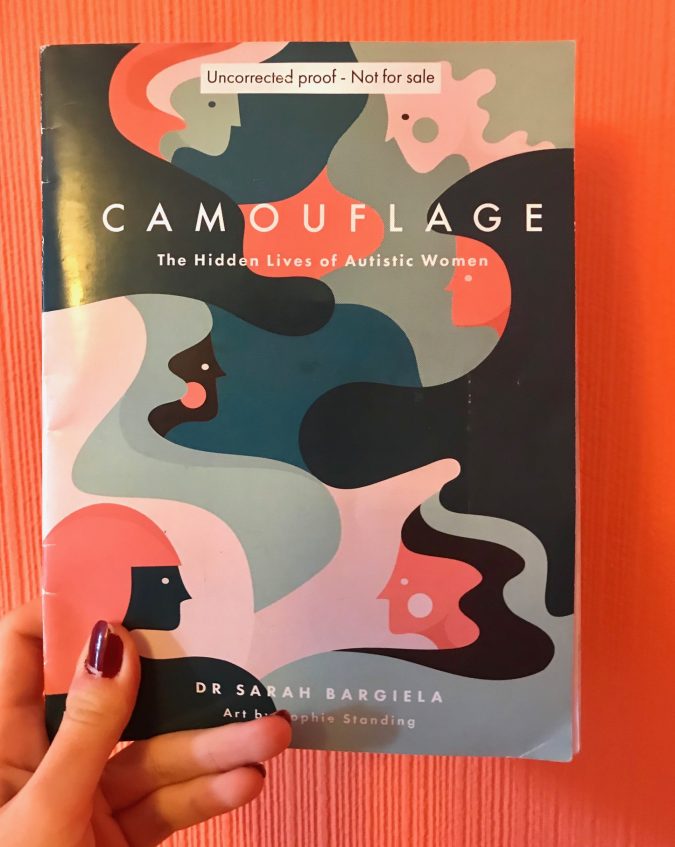
Camouflage
Camouflage was gifted to me prior to release by the publisher, for an article I was writing at the time.
The thing about Autism is that, well, the narrative is biased. Men are typically diagnosed more, and at an earlier age, too. Why? Well, up until a while ago, women apparently couldn’t be Autistic! And the diagnostic criteria has been written with men in mind, when women tend to ‘present’ far differently. Add a few other factors in, and women are still being missed out. I think I was, too; it took three and a half years for a diagnosis, but the obviousness was always put down to ‘she’s just … quirky.’
Anyway: Camoflauge, in the format of a graphic novel, essentially bridges that gap. It also explores why Women are diagnosed less, what the difference between presenting hallmarks is, and more.
Stim
Spoiler alert: I haven’t actually read this book! I was supposed to go to the Foyles Bookshop event, a kind of ‘public launch’. The spread of Covid 19 saw to that…
Stim is an anthology of Autistic people …. Who aren’t necessarily writing about Autism! There are illustrations, stories, differing pieces of writing… Because Autistic people are doing it for themselves, at last!
I also like how the book title is stereotype-busting. Stimming is a repeated behaviour, such as hand flapping, touching hair, tapping, which acts as a self-soothing mechanism. (My friend, who didn’t know I was on spectrum, said that I sometimes look like I’m about to “take off” when agitated. She had found out about my diagnosis five minutes before.) It’s a behaviour that can be highly stigmatised; ‘normalising’ it would be wonderful.
To find out more, you can read my interview with the editor here.
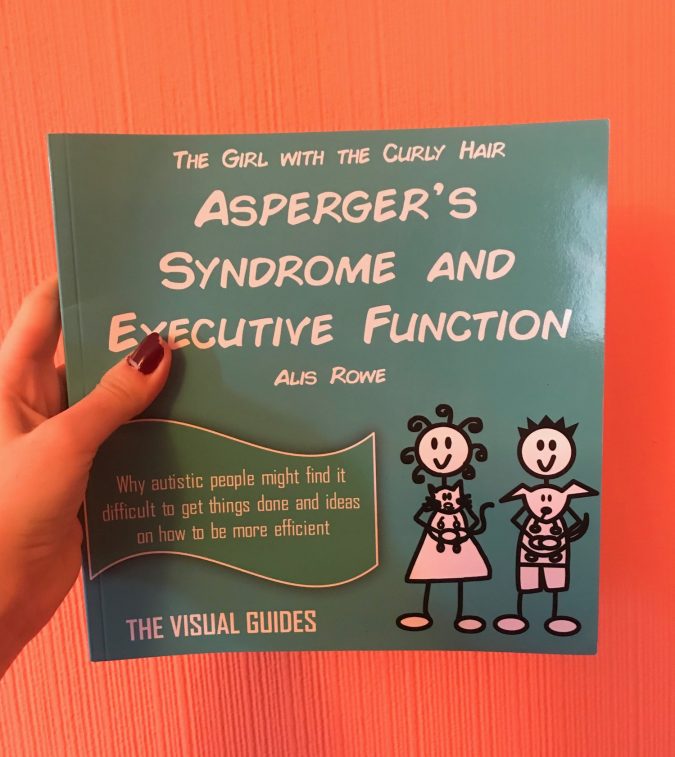
Aspergers Syndrome and Executive Function
Disclaimer: the author is technically my boss..! But I found this book helpful to me, personally.
How to define Executive functioning? To quote from the book: “Executive function is a set of mental skills that help people get things done…. It is thought that people on the autistic spectrum have impaired executive function.” Examples of executive functioning could include things like: working memory, organisation, starting tasks, controlling impulses. self-monitoring.
This is just the basics. And Autism is a spectrum condition, meaning it can be vary for anyone.
I have some issues with this – and at the time of my diagnosis, no one explained this to me. And no strategy to work around the issue was in place, either. (Catch up time!) But this book finally explained to me that I am doing my best, and it is not necessarily my fault. And I’d love for people not on the spectrum to understand this more.
Have you been diagnosed with autism? What books have you found useful?